Quick Facts
- International shoppers buying from Canadian retailers
- Tourists planning shopping trips to Canada
- Americans confused about Canadian sizing
- Canadian clothing sizes are 90% identical to US sizes - no conversion needed for mainstream brands
- Canadian shoe sizes are exactly the same as US sizes for men, women, and children
- Heritage/Quebec brands may use European-style numeric sizing where Canada 36 = US size 2
- Children's clothing uses the same T-system as the United States
Skip the complex conversion charts - if you know your US size, you already know your Canadian size for most mainstream retailers. Only boutique or heritage brands require European-style conversions.
If you are shopping online from a Canadian retailer or planning a shopping spree in Toronto, you might panic when looking for a size chart. Does Canada use the metric system for clothes? Do you need to convert inches to centimeters?
Here is the short answer: Rarely.
Contrary to popular beliefand many outdated blog postsmainstream Canadian clothing sizing is almost identical to US sizing. However, there are specific exceptions for high-end heritage brands that can trip you up. We have curated this guide to help you distinguish the rule from the exceptions so you can buy with confidence.
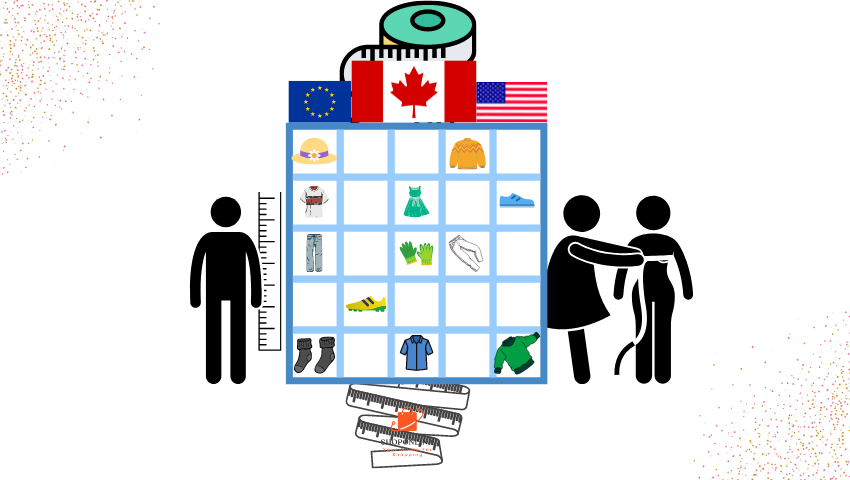
The Golden Rule: Canada vs. US Sizing
Before you dive into complex conversion charts, you need to know the landscape. Canada is a unique hybrid market. While the government uses the metric system, the fashion industry is heavily integrated with the United States.
- Mainstream Retail (The 90%): Brands like Lululemon, Roots, and The Bay use standard US sizing. A US Medium is a Canadian Medium. A US size 6 is a Canadian size 6.
- The “Heritage” Exception: Some high-end designers or Quebec based brands (like Meemoza or older Canada Goose charts) may use a numeric system similar to Europe. In this specific case, a “Canada 36” would equal a US size 2.
If you are looking for specific shopping destinations, check out our guide to the Best Flea Markets in Canada to put this knowledge to use.
Canadian Shoe Sizes: The Reality Check
This is where most internet guides get it wrong. They often display European conversion tables for Canada. Ignore them.
Canadian shoe sizes are identical to US sizes for men, women, and children. There is no “Canadian specific” shoe measurement. If you wear a size 7 in New York, you wear a size 7 in Vancouver.
Women’s Shoe Size Conversion
| US/Canada Size | UK Size | EU Size | Foot Length (approx.) |
|---|---|---|---|
| 5 | 3 | 35-36 | 8.5″ (21.6 cm) |
| 6 | 4 | 36-37 | 8.8″ (22.5 cm) |
| 7 | 5 | 37-38 | 9.25″ (23.5 cm) |
| 8 | 6 | 38-39 | 9.5″ (24.1 cm) |
| 9 | 7 | 39-40 | 9.8″ (25.1 cm) |
| 10 | 8 | 40-41 | 10.2″ (25.9 cm) |
Men’s Shoe Size Conversion
Just like women’s footwear, men’s sizing is standard across North America.
| US/Canada Size | UK Size | EU Size | Foot Length (approx.) |
|---|---|---|---|
| 7 | 6.5 | 40 | 9.6″ (24.4 cm) |
| 8 | 7.5 | 41 | 9.9″ (25.4 cm) |
| 9 | 8.5 | 42 | 10.25″ (26 cm) |
| 10 | 9.5 | 43 | 10.56″ (27 cm) |
| 11 | 10.5 | 44 | 10.75″ (27.9 cm) |
| 12 | 11.5 | 45 | 11.25″ (28.6 cm) |
Women’s Clothing: Navigating the “Numeric” Exception
While 90% of stores use the Alpha system (XS, S, M, L) that aligns with the US, you may encounter the “Numeric” system in boutique stores. This is where it gets tricky. A Canadian numeric ’36’ is not a 36-inch waist; it corresponds to a US size 2.
If you are shopping internationally, here is how the conversion works. Note how similar this is to manufacturing standards in the USA.
| US Standard | Canada (Alpha) | Canada (Numeric/Heritage) | UK Size | EU Standard |
|---|---|---|---|---|
| 0 | XXS | 34 | 4 | 32 |
| 2 | XS | 36 | 6 | 34 |
| 4 | S | 38 | 8 | 36 |
| 6 | M | 40 | 10 | 38 |
| 8 | M/L | 42 | 12 | 40 |
| 10 | L | 44 | 14 | 42 |
| 12 | XL | 46 | 16 | 44 |
Men’s Suit and Shirt Sizes
If you are buying a suit in Montreal or Toronto, the system is based on chest measurements in inches. It is identical to the US system and does not typically use the European sizing (where a 40 US is a 50 EU).
- Suits: A Canada size 40 suit = US size 40. The EU equivalent is usually chest size + 10 (Size 50).
- Dress Shirts: These are sized by neck and sleeve length in inches (e. g., 16 neck / 34 sleeve).
- Casual Shirts: Standard Alpha sizing (S, M, L, XL).
Children’s Clothing: The “T” System
Parents can breathe a sigh of relief. Canadian children’s clothing uses the exact same “Toddler” (T) and age based system as the United States. There is no conversion math required here.
If you are shopping for clothes for the little ones, accuracy matters. Always check if the store is a reliable vendor. For tips on verifying online stores, read our review: Is Interconnect Shop Legit? A Comprehensive Review.
| US/Canada Size | Approx Age | Height (inches) | Weight (lbs) |
|---|---|---|---|
| 2T | 2 Years | 33-35″ | 24-29 lbs |
| 3T | 3 Years | 35-38″ | 29-33 lbs |
| 4T | 4 Years | 38-41″ | 33-37 lbs |
| 5 | 5 Years | 41-44″ | 37-43 lbs |
| 6 | 6 Years | 44-46″ | 43-50 lbs |
Editor’s Tip: While US and Canadian sizes are technically the same, Canadian outerwear brands (like winter coats) often run slightly larger to accommodate layering. If you are between sizes on a parka, check the specific brand measurements.